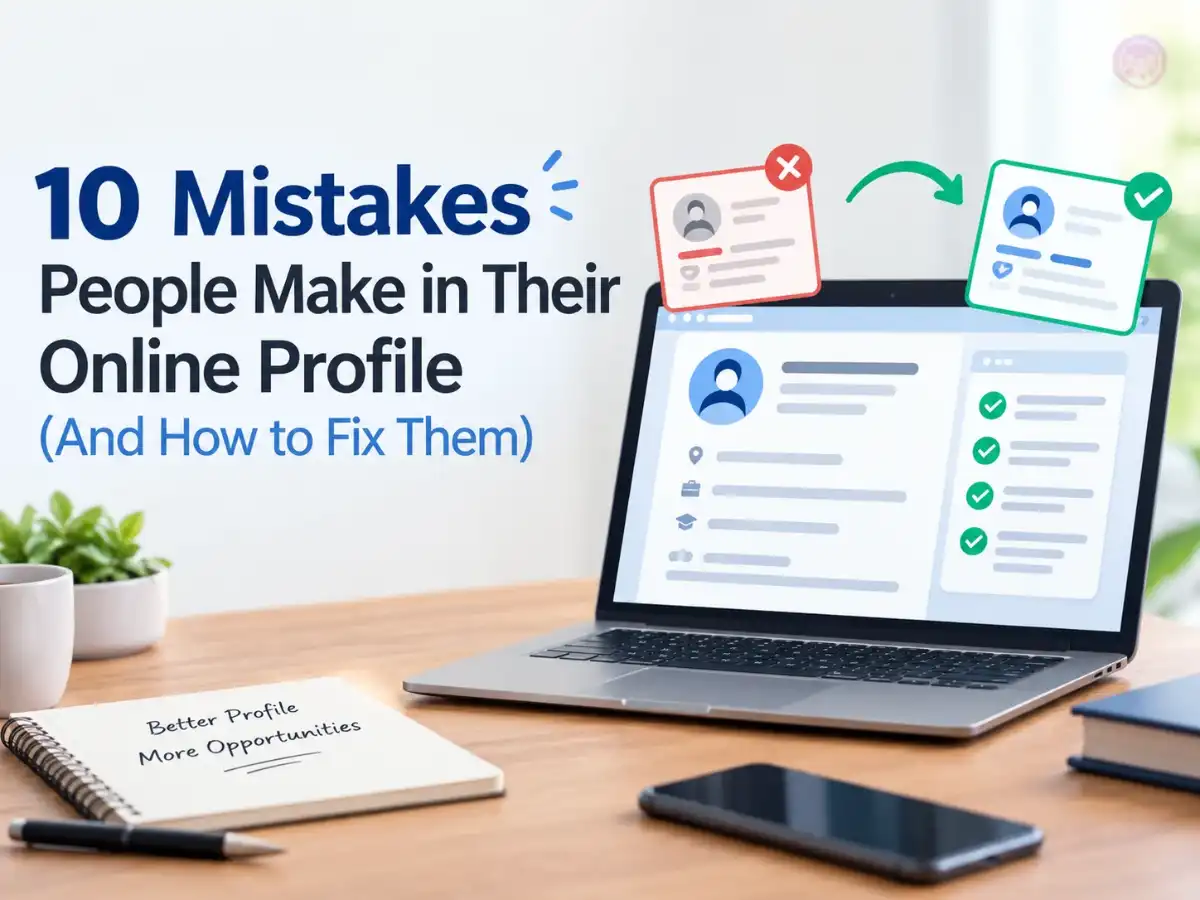
Your online profile is usually the first place people visit when looking for you as a professional. Poor or inconsistent performance in this sphere might cost you chances even if you are qualified. Most professionals sign up on all the leading social networking sites however, they still do things that might be easily avoided.
Most common mistakes made in your online profile are related to personal branding, photo usage, content quality, or incomplete sections. The good news is that most of them can be fixed very quickly, and they will bring much more clarity to your professional image.
Quick Answer
Most common mistakes in online profiles are defined personal branding, inconsistent messaging, lack of a photo or a bad choice of photo and banners, and incomplete About section, lack of one central website hub, outdated content, and failure to google your own name. Fix these mistakes by writing down your brand, using a professional photo and banner, and writing an About section in the first person, build a simple personal website, update content regularly, and Google yourself once a month.
1. You Haven’t Defined Your Personal Brand
It is not sufficient to simply sign up on LinkedIn, Instagram, or some other websites to create a personal brand. The lack of a personal brand definition leads to disorganized posts and profiles.
Create one simple sentence about your personal brand. Make sure you can see this sentence each time you update your profile so that all parts are aligned.
2. All Your Profiles Are About Your Past
A lot of bios include outdated information such as past positions, accolades, and published materials rather than current achievements and future plans. It becomes particularly problematic if you are experiencing a career change.
Update all your bios and make them relevant to your current state and your future goals. The updated version will become a guide for all other online content.
3. Your Personal Brand Is Inconsistent
One of your platforms may show you as a strategist while the other may show you as an experienced copywriter. Different representations of yourself may confuse the audience.
Choose one identity to represent yourself and use it on all platforms. You can put one sentence about your personal brand next to your workplace.
4. You Never Refresh Your Brand
Your career aspirations and interests evolve. A static online profile does not reflect who you are anymore.
Set yourself an alert once every six months to assess your brand message, bios, and photos. Replace anything that is no longer relevant to you.
5. Your Profile Picture Doesn’t Align With Your Brand
Whether it is no picture at all, an outdated office portrait, or a night out picture, an unprofessional picture gives an impression that isn’t good to start with. Most people ignore the connection request if there is no picture associated with your profile.
Upload a current, high-resolution picture against a neutral background and align it with your brand color if you can.
6. You Don’t Have an Effective About Section or Banner
A blank About section is wasted opportunity to tell the world what value you offer and the results you produce. The same goes for an unimpressive gray banner.
Create a first-person About section with up to 2,600 characters, including white spaces and emphasizing your value. Also create a custom banner that emphasizes your work, website, or present offer. Test how it looks on mobile devices to ensure you see all the necessary information.
7. You Don’t Regularly Check Your Google Results
Recruiters or new connections will be searching for your name online. Should they find some other person, outdated and embarrassing information, or anything not relevant, then the wrong story will be spreading about you.
Search your name using a private window monthly. Study the first page of the search results and images, and remove or change anything that you have control over. If it’s something you cannot change, ask the owner or just build better results higher in rankings.
8. Not Having a Hub
Lacking a website or even just a landing page, all your search results become dispersed, and you have no control over the central theme.
Build a one-page website that acts as a portfolio of sorts. Include links to other pages of yours and rank for your name. A minimum-effort version will take no more than an hour.
9. All Your Posts Are About You, or They Are About No One
Posting about yourself all the time is going to drive people off. Posting nothing about yourself gives no clue as to who you are and what you do.
Strive for a balance here. Post some helpful articles or congratulate someone else but then, after some time, share something that you accomplished yourself or your own insight into whatever topic you write about.
10. You Leave Typos or Your Profile Is Dormant
Typos make people believe that you don’t pay enough attention to details. Abandoned profiles on older websites give out negative signals and show up when someone looks for you.
Check each post before posting it. If possible, read it out loud as you type. Close old profiles.
How to Upgrade Your Online Profile: Step-by-Step
The process begins with the photo, About and brand sections. These form initial perceptions. The second step involves Googling your name and fixing any negative results. Third, create/update your basic landing page. Last, review your content for coherence and interaction potential.
Nepalese professionals, and others in Kathmandu, will appreciate the advice since online research and social networks have transcended geographical boundaries. A neat profile is relevant in both local and international searches.
For a free way to create a polished online presence, explore tools that let you build a professional page quickly. If your existing website feels outdated, a redesign can support the stronger profile you are building. You can also use a free image converter to prepare photos for your profiles.
FAQs
What are the most common online profile mistakes?
Undefined branding, poor-quality photos, incomplete About pages, inconsistent messaging, and never checking your Google results are some of the most common mistakes.
How can I build a professional online reputation fast?
Make sure to update your photo and banner, craft a first-person About section, formulate a one-sentence branding statement, and create an easy-to-understand landing page. See this guide on creating a free online profile for more steps.
Why is personal branding important for my online presence?
Having a brand gives others insight into who you are and what you can do.
Will I continue using my old social media profiles?
Only if they are relevant to your present brand, because irrelevant accounts will only weaken your search results.
How frequently do I need to maintain my online profiles?
You need to maintain them once every six months or whenever your career path changes. More questions are answered on the FAQ page.
Conclusion
Avoiding such mistakes when creating an online profile will result in a more distinct and professional online presence for career advancement. Develop your brand, keep your pictures and sections up to date, manage your search results, and stay consistent with all platforms. It is better to make smaller, regular updates rather than big changes once in a while. Explore more advice on the blog.